The Repair Diary: A Small Record That Prevents Repeat Guesswork
A repair diary helps you remember household care, materials, and timing, so routine upkeep starts with a useful record instead of another round of guesswork.
What did you use on the dining table last time, and did it leave a dull patch? A repair diary keeps that answer somewhere more dependable than memory. For routine household upkeep, a short record of what you cared for, when, and with which materials can prevent repeat guesswork without turning your home into a maintenance department.
The useful version is modest: enough detail to recognize a recurring task and make a sensible next decision. It is not a technical repair manual, a warranty file, or an invitation to take apart anything that works. Think of it as a household memory aid, with room for uncertainty when you do not know exactly what happened.
Choose a record that matches how you remember household tasks
The best format is the one you will consult when a familiar task comes around again. Choose based on how you already handle notes, not on an ideal system you hope to become the sort of person who maintains.
- Use a paper notebook if you like keeping household information together in a drawer or kitchen desk. A plain notebook works; reserve a few pages for an index so “window screens” is easier to find than “somewhere in spring.”
- Use a notes app if your phone is usually nearby and search is more useful to you than browsing pages. Apple Notes, Google Keep, or another familiar app can hold brief entries and photos without requiring a separate account for household upkeep.
- Use a shared digital note if more than one person handles routine care. A shared note in Google Docs or a household app can make the record visible to the person who actually notices the loose cabinet pull, rather than only to the person who once promised to write it down.
- Use a folder with paper slips if care information arrives on product cards, receipts, or labels. Keep the original information where you can find it, then add a short note about what you did and what you observed.
Do not split the record across several systems unless there is a clear reason. A notebook plus a phone photo can be sensible; a notebook, three apps, a calendar, and a spreadsheet tend to create a second task: remembering where the first task was recorded.
Start with the objects that create repeat questions
A diary need not inventory every possession. Start with things that have recurring care needs, uncertain materials, or household instructions that are easy to forget. Common candidates include wooden furniture, rugs, coats, cookware, window coverings, and small appliances with care cards.
Prioritize an object when you hear yourself ask, “What did I do last time?” or “Was that before or after we changed the cleaner?” A note can be useful even when the answer is simply that you do not know. Recording uncertainty is better than quietly converting a guess into household lore.
Skip items whose upkeep is obvious and infrequent unless a particular detail matters. The diary is not improved by recording every time someone wipes a countertop. It is improved by capturing information that changes what you would do next: a finish reacted poorly, a particular cloth left lint, or the manufacturer’s care card is stored in the hall closet.
Write entries around the next decision
A good entry is short enough to make while the task is fresh and specific enough to help later. Include the date or season, the object, the care action, materials used, and what you noticed afterward. Add a reminder or source location only if it will help someone decide what to do next.
- When: “Early fall” may be adequate if exact dates do not matter to the routine.
- What: Name the object and its location, such as “blue wool coat, front closet.”
- Care performed: Describe the action in ordinary terms, such as “brushed surface” or “wiped with a damp cloth.”
- Materials: Note a product name, cloth type, or other detail you may need to identify again. If you cannot identify it, say so rather than inventing certainty.
- Observation: Record a visible result or a reason to pause next time, such as “water mark remained” or “care label still attached inside pocket.”
- Next decision: Write a brief prompt, such as “check label before cleaning again” or “ask cleaner about the lining.”
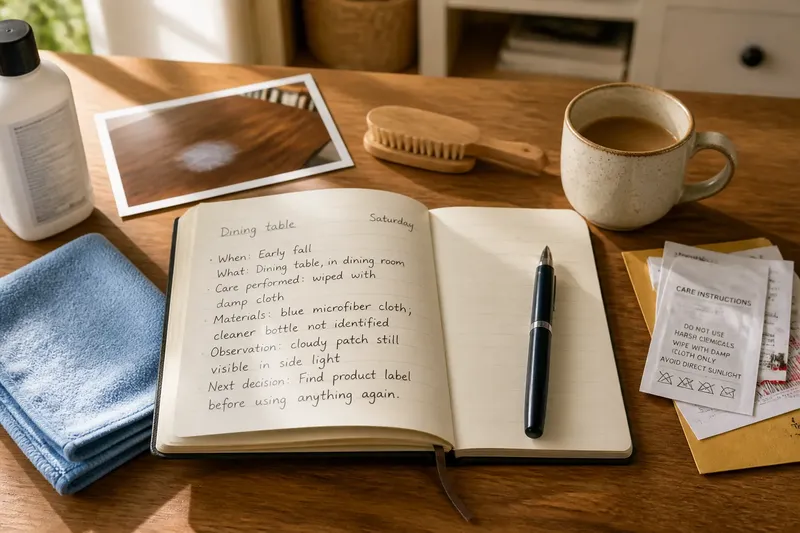
Say you have a dining table with an unknown finish, and you are not sure which spray was used before a cloudy area appeared. An entry might say, “Dining table, Saturday: wiped with a blue microfiber cloth; cleaner bottle not identified; cloudy patch still visible in side light. Find product label before using anything again.” The point is not to diagnose the finish. It is to preserve the observation and avoid repeating an unidentified action as if it had been harmless.
For products or materials with specific care requirements, the item’s label, manufacturer instructions, and local rules take precedence; consult a qualified professional when the matter calls for one. The diary can point to that guidance, but it should not replace it.
Sort your approach by the kind of uncertainty you face
A decision guide is more useful than one elaborate template because households have different reasons for losing track. Pick the situation that sounds most like yours and keep the record focused on that problem.
If you forget when routine care was last done, use a date-led note
Record the object, the date or season, and the task completed. This fits recurring care such as cleaning a rug or checking the condition of outdoor cushions, where the timing is more useful than a detailed account of every movement.
If you forget which material or product you used, use a materials-led note
Write down the product name or a clear description of the cloth, brush, or other material, then note what you observed. This is useful when bottles look alike or when several household members rotate through the same task. A photo of the label can save a later trip to the cupboard.
If the result was unclear, use an observation-led note
Describe what you can see without assigning a cause: “edge remains rough” is more dependable than “the oil failed” if you do not know the surface or product. This approach fits items that change slowly, where a later comparison may help you decide whether ordinary care is enough or whether to ask a specialist.
If several people share upkeep, use a handoff note
State what has been done, what remains unknown, and where relevant instructions are kept. This is a better fit for shared homes than relying on a verbal exchange that might happen while someone is carrying laundry and listening to a kettle.
Review the diary when a task returns, not on a fixed schedule
The diary earns its space at the moment you face the same question again. Search the object name, check the previous entry, and compare it with what you can observe now. If the notes are thin, treat them as a clue rather than an instruction.
When a routine changes, record the reason. Perhaps a new care label turns up, a product is discontinued, or another household member takes over. A short note such as “use instructions from new cushion tag; old note referred to previous covers” prevents an obsolete entry from sounding authoritative merely because it is written down.
It is also sensible to correct a record openly. Add a new entry that says the earlier note was mistaken, rather than silently editing away the old information if another person may have relied on it. The purpose is a usable memory, not a flawless archive.
Keep sensitive or technical work outside the diary’s authority
Routine care notes are appropriate for observations and ordinary household tasks. They should not become instructions for structural, electrical, gas, chemical, or other safety-critical work. If an entry begins to sound like a procedure for opening equipment, mixing products, or altering a building component, stop treating it as a household reminder and seek qualified guidance.
Similarly, do not infer that a material is safe for a product because it was used on something that looked similar. Similar-looking surfaces can have different finishes, coatings, or care requirements. Record what is known, keep the relevant label or manufacturer information, and mark the rest as unknown.
A useful repair diary is small because its job is small: to carry forward the details that routine memory drops. Record the action, the materials, and what you noticed; make the next decision from that record and the guidance that applies to the object. When you search for a repair diary later, the best result is not a perfect history. It is a clear note that helps you avoid repeating a guess.