The Hidden Work of a Well-Made Hinge
Learn how a well-made hinge manages alignment, repeated motion, and contact between parts so you can judge construction without attempting repairs.
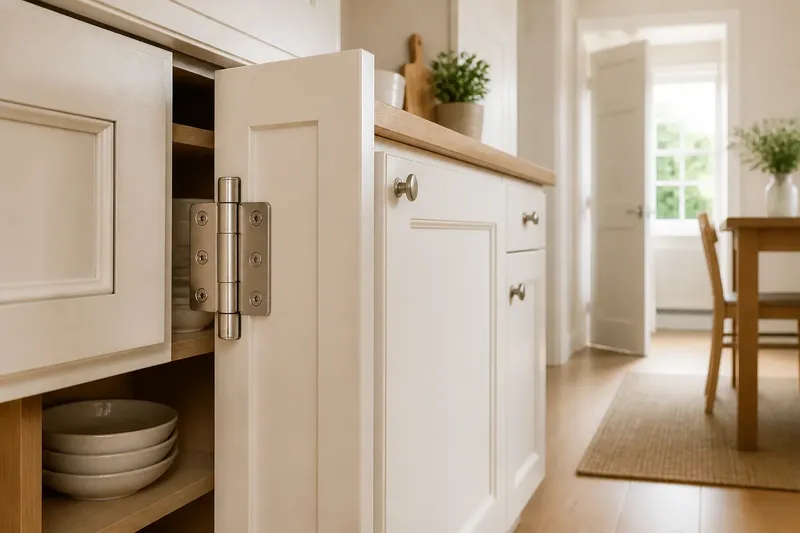
How can you tell whether a hinge is thoughtfully made without taking it apart? Start by watching the door move. A well-made hinge is not merely a pair of metal leaves joined by a pin; its parts must stay aligned, turn repeatedly, and meet without needless rubbing or looseness. The details are modest, but they shape the feel of a cabinet door, gate, or interior door every time it moves.
A hinge guides motion by holding two surfaces in line
Most familiar hinges share a simple arrangement. One leaf attaches to each moving surface, while curled knuckles along the leaves fit together around a pin. The pin forms an axis: the line around which the door turns. When the leaves are mounted in a suitable position, the axis stays steady as the door opens and closes.
That steadiness is the hinge’s first quiet job. It keeps the door from wandering sideways while allowing it to swing. A hinge can look sturdy on a workbench and still feel poor in use if the leaves sit crooked, the pin is loose, or the door’s weight pulls the assembly out of line. Construction and placement work together; neither can be judged from metal thickness alone.
Look at the gaps around a closed door and at the way it begins to move. Even spacing suggests that the door and its hinges are meeting in a coherent arrangement. A door that shifts, catches, or scrapes may indicate a problem somewhere in that arrangement, but the observation alone does not identify the cause. For this kind of assessment, the useful question is not “Which part should I fix?” but “What is the hinge being asked to do?”
Repeated motion makes small differences matter
A hinge moves through a small arc, then returns to its starting position. That movement repeats, and every cycle brings the same surfaces back into contact. A pin turning inside aligned knuckles can guide that motion smoothly. If the parts are poorly matched or the axis is uneven, contact may concentrate at one point instead of being shared along the joint.
That distinction is easy to miss in a still photograph. In motion, listen for a regular, quiet swing rather than a scrape or a clack, and notice whether the door follows a consistent path. These signs do not certify the quality of the metal or the precision of the fit. They do tell you that the hinge is moving in a particular way, which is a more useful starting point than treating “heavy” as a synonym for “well made.”
Imagine you are comparing two cabinet doors in a shop. One closes with a small, even gap and swings without a visible sideways shift; the other drags near the frame and makes its edge jump as it moves. You can record those observable differences without opening either hinge or deciding what repair is needed. The first door gives you evidence of more consistent movement as installed, not proof that every hidden component is superior.
The meeting between parts reveals more than a finish
The hinge’s leaves, knuckles, and pin each have a job, but their contact is where the assembly becomes a working joint. Knuckles should line up along the pin rather than appear visibly stepped or twisted. The pin should sit in the joined knuckles without an obvious gap that lets the leaves wobble. A polished surface may make a hinge look refined; the fit between these parts is what lets refinement survive ordinary use.
Surface treatments can protect metal or change its appearance, but a coating cannot correct misalignment. Likewise, a broad leaf or thick-looking barrel may suit a particular door without saying much about how carefully the pin and knuckles meet. When comparing hardware, look for clean, regular edges and a consistent join, then consider whether the hinge is intended for the door’s role. Cabinet hinges, strap hinges, and butt hinges serve different arrangements, so appearance is not a universal ranking system.
Mounting also affects what you can observe. Screws hold the leaves in place, and the recesses cut into the door or frame determine how the hinge sits. If a leaf stands proud or the door’s gaps are uneven, the issue could involve placement as well as the hinge itself. A visual inspection can describe the condition; it cannot reliably assign blame to one component.
Hinge quality is easier to notice while the door moves
Use the same simple observations across different doors: alignment, sound, smoothness, and the way the door settles when released. Avoid forcing a door that sticks or lifting it to test the joint. The point is to notice ordinary movement, not to turn a visit to a shop or a room inspection into an improvised repair session.
- Alignment: Check whether the door sits evenly in its opening and whether the hinge knuckles appear to share a straight axis.
- Movement: Notice whether the door swings through a steady path or shifts sideways as it opens.
- Contact: Listen for rubbing, scraping, or a sharp clack that repeats at the same point.
- Fit: Look for visible gaps between joined parts or a pin that seems to move independently of the knuckles.
- Context: Consider the door’s size, weight, and use before comparing one hinge style with another.
These checks describe what is visible and audible. They do not establish whether a hinge is safe to carry a particular load or whether a door needs adjustment. For specifications and any work involving a heavy or potentially hazardous door, follow the maker’s instructions and consult a qualified professional when appropriate.
Why does a hinge move unevenly?
Can a hinge look solid and still move poorly?
Yes. Thick leaves or a substantial barrel cannot compensate for parts that are out of line or a door that is poorly positioned. Watch the movement and the door’s gaps rather than judging by bulk alone.
What does a hinge pin do?
The pin passes through the joined knuckles and provides the axis around which the leaves turn. Its relationship to those knuckles helps determine whether the joint moves steadily or allows visible play.
Does a squeak identify a worn hinge?
No. A sound can come from contact at the hinge, the door rubbing elsewhere, or another condition in the assembly. Treat it as an observation, not a diagnosis, especially if the door also shifts or binds.
What should I compare when choosing a hinge?
Compare the intended application, visible fit, and movement of a door using that hinge, rather than relying on finish or apparent weight. The hinge must suit the door and its mounting arrangement, not merely look substantial on a display card.
Good construction shows itself in ordinary movement
The hidden work of a well-made hinge is coordination: leaves held in line, knuckles meeting around a pin, and repeated motion occurring without conspicuous drag or wobble. For a durability-minded choice, the most useful clues are the ones you can observe without dismantling anything. A hinge that looks unremarkable while its door moves evenly is doing its job with the sort of discretion most hardware can only aspire to.
When you compare hinges, keep the door in view. The same fitting can behave differently in another installation, and a handsome loose hinge cannot reveal every detail of its future service. The practical judgment is narrower and stronger: notice how the parts meet, how the movement proceeds, and whether the hardware suits the task in front of it.