A Family Recipe Card That Can Travel Across Generations
A family recipe card can carry readable instructions and the dish’s meaning together, so the next cook can make it without guessing what mattered.
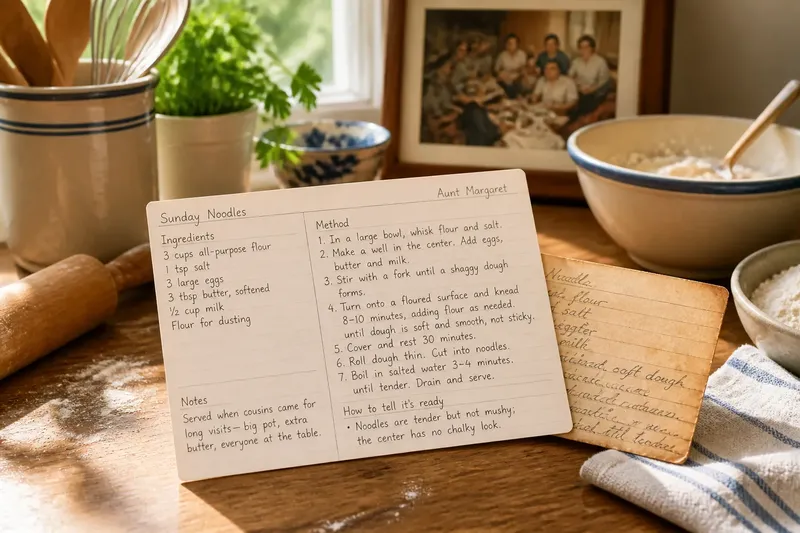
How do you make a family recipe card useful to someone who never watched its original cook? A family recipe card can travel across generations when it preserves two things together: instructions a new cook can follow and a short account of why the dish belongs at a particular table. The aim is not to recreate a relative’s handwriting or document an entire family history. It is to make the next occasion possible.
What should a family recipe card preserve?
Preserve the decisions that affect the food, not every detail of the original kitchen. A card that says “a little flour” may be clear to the person who wrote it and unhelpful to someone else. Add a workable amount or a cue that can be observed, such as “add flour until the dough is soft enough to shape without sticking.” If the amount matters to the result, give a measure.
Keep the recipe’s identity as well. A name such as “Sunday noodles” may be more useful than a formal dish name if that is what the family calls it. Record who taught it, when it was usually served, or what made it the dish everyone expected. One specific detail is enough to give the instructions a setting.
Think of the card as a handoff between cooks. It should answer what to gather, what to do, what to watch for and how to tell when the food is ready. It need not settle every preference. A cook can choose a serving bowl; they should not have to guess whether the dough is meant to rest.
How should you make the recipe readable?
Make a clean copy in a format that suits the next cook. A recipe-card template in a word processor, a plain text document, or a neatly written index card can all work. Choose a typeface and size that remain comfortable to read, and leave enough space to distinguish ingredients from instructions. Avoid pale ink, cramped margins and decorative script that turns a familiar recipe into a decoding exercise.
Separate ingredients from method. Write amounts beside ingredient names, then put actions in the order they happen. If an ingredient is divided, say so at the point of use: “butter, divided” in the list and “stir in the remaining butter” in the method. Spell out a shorthand term when the new cook might not know it. “Bake until set” is clearer if paired with a visible cue, such as a center that no longer looks liquid.
Keep the original card if it matters to the family, but do not make it the only usable copy. A scan or clear phone photograph can preserve the look of the handwriting; a typed version can preserve legibility. If the old card is difficult to read, compare it with a family member’s recollection and mark uncertain wording rather than quietly converting a guess into an instruction.
What context belongs beside the instructions?
Add a short note that explains the dish’s place in family life. The note might say that it appeared when cousins visited, that it was made for a particular holiday, or that the cook always set aside a portion for someone arriving late. This is context, not a biography. A few plain sentences can explain why someone might want to make the dish even if they have never tasted it.
Be concrete and selective. “A favorite for special occasions” could describe almost anything. “We made it after the first snow, when everyone came in from outside” gives a future cook a scene and a reason. If the occasion has changed, say so without making the dish dependent on one person or one household’s schedule.
Say you are copying an aunt’s handwritten card for a cousin who has never made the dish. You type the ingredients and method, add the visual cue she remembers for doneness, then write that the dish was served when relatives arrived for a long visit. The cousin can cook from the readable copy and understand why the dish is associated with gathering, without needing to imitate the aunt’s handwriting or guess what “until it looks right” meant.
How much should you change in a family recipe?
Change what removes avoidable uncertainty, and keep a distinction between the inherited wording and any later adjustment. If a vague instruction can be clarified without changing the cooking method, clarify it. If a family member remembers a meaningful variation, record it as a variation rather than silently replacing the original.
For instance, the card can say “Original note: a pinch of nutmeg,” followed by “At our house, we usually leave it out.” That preserves both the earlier instruction and the family’s current preference. It also avoids presenting one person’s version as the only authentic one.
When a recipe depends on an ingredient or piece of equipment that may be unfamiliar, name the item plainly and offer a reasonable description. “Use a heavy-bottomed saucepan” gives more direction than “use the usual pot.” If a substitute changes the texture or flavor, describe that trade-off instead of pretending the result will be identical.
What should you check before handing the card to another cook?
- Ingredient amounts: Are quantities attached to the right ingredients, and are divided amounts explained?
- Order: Does each action appear when the cook needs to do it?
- Timing cues: Does the method describe what to look, smell or feel for where time alone may not help?
- Unfamiliar terms: Have family shorthand and specialized tools been clarified?
- Uncertain details: Are remembered guesses identified instead of presented as settled instructions?
- Context note: Does it explain the occasion or meaning in a way a new relative can understand?
- Copy quality: Can someone read the card easily, and is the original kept separately if it is fragile?
Then ask a person who did not grow up with the recipe to read it. Ask where they would pause, not whether they like the dish. Their questions may reveal an unexplained phrase or a missing cue. Treat that as a chance to clarify the handoff, not as a verdict on the family cook.
Can a recipe card include personal or dietary details?
Yes, if those details help a future cook make the dish safely and understand its variations. Note ingredients that are central to the recipe, and distinguish optional additions from required ones. If someone in the family avoids an ingredient, keep that note specific to the version it describes rather than implying that every copy is suitable for every person.
Food needs and product formulations can change. For allergy or other medical concerns, the person eating the dish should check current ingredient labels and consult a qualified professional where needed. A family card can preserve a useful reminder, but it cannot establish that a recipe is suitable for someone’s present health needs.
How can the card stay useful without becoming an archive?
Keep the preservation effort close to the occasion. Make the readable copy when the dish is being prepared or discussed, while someone can answer questions about an unclear step. Add the context note then, too; memories tend to become less precise when they are left for a mythical quieter afternoon.
Give the copy to the person who is likely to make the dish next, or keep it with the family’s recipe collection where a cook will look for it. A dated note can distinguish a fresh clarification from the older wording, but a formal catalog is unnecessary. The goal is not to build a comprehensive record. It is to put the right information within reach when the dish is wanted.
Review the card after someone cooks from it, especially if a missing cue caused hesitation. Record the clarification in ordinary language and keep meaningful variations visible. A family recipe card lasts through use when it gives the next cook both a workable method and a reason to bring the dish back to the table.